What should Amazon seller analytics software do?
Amazon seller analytics software should put your sales, ad, inventory and listing numbers in one place and keep them over time. That is harder than it sounds. Amazon spreads the data over Ads, Seller Central, Vendor Central, Brand Analytics, DSP and Marketing Stream, each with its own authorization, data shapes and rate limits. [cs-site]
Tools in this category mostly fall into two groups. Dashboards show fixed screens. Data layers store the numbers and let your own software ask the questions. Commerce Spine is a data layer: a managed warehouse with a read-only API that your own AI agent queries, as the how it works section shows. [cs-site]
The checks below work for any tool you compare. Each one gives Commerce Spine's answer as the worked example, taken from the limits printed on its own pricing section. [cs-site]
What to check before you buy
Start with coverage, history and access, because they decide which questions you can still ask a year from now. The table puts Commerce Spine's answer next to each check. The data coverage overview lists every source in detail. [cs-site]
Two rows deserve a closer look. A tool that needs write access can change bids or listings, so ask what it does with that access. A tool without stored history has to pull the same data again for every comparison. [cs-site]
Ask how the tool tells you a number is current. In Commerce Spine, dataFreshness returns the latest report date per asset, and the console shows the last successful sync for every live entity. Your agent can print that date at the top of each answer. [cs] [cs-site]
Check the advertising grain as well. Commerce Spine reads Sponsored Products, Sponsored Brands and Sponsored Display from campaign level down to the search term. The reference documents keywordPerformance, searchTermPerformance and productTargetPerformance as separate entities, each with spend, clicks, orders and revenue. [cs] [cs-site]
| What to check | Commerce Spine |
|---|---|
| Amazon sources joined | 6: Ads, DSP, Marketing Stream, Seller Central, Vendor Central, Brand Analytics |
| Documented columns | 316 |
| History | 30 days backfilled at first sync, then kept from that day |
| Freshness | Performance daily, Brand Analytics weekly, last sync shown per entity |
| Write access to your account | None, every token is read-only |
| Who asks the questions | Your own AI agent or script |
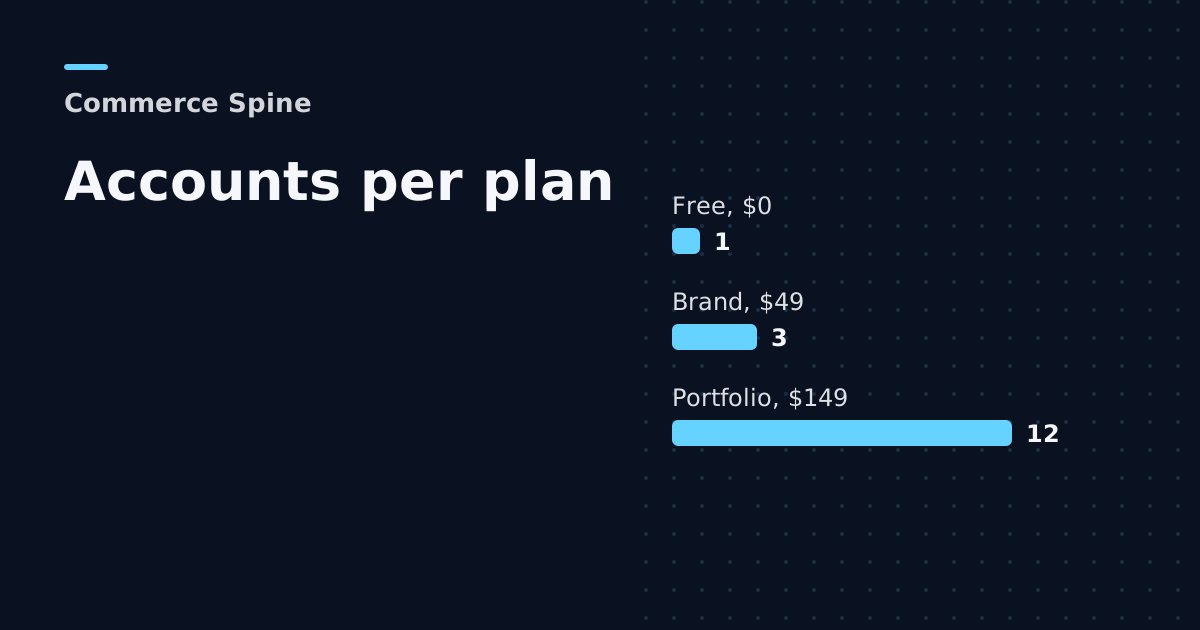
| Price | $0 for 1 account, $49 for up to 3, $149 for up to 12 |
How much history does the software keep?
Commerce Spine keeps everything from your first sync onward, after a 30-day backfill on every plan. According to Commerce Spine's plan notes, Amazon caps historical data at 90 days and releases about 30 in practice. Your history therefore grows with every week you stay connected. [cs-site]
This is where a warehouse and a connector part ways. A connector asks Amazon's live endpoints and keeps nothing once the call ends. A warehouse stores and joins the data, so comparing this week with the same week last quarter becomes one query. [cs-site]
One query covers at most 30 days on the free plan and 90 days on a paid plan. On a paid plan, a range over 90 days returns DATE_RANGE_TOO_LARGE, so a 180-day trend takes 2 queries of 90 days each. [cs] [cs-site]
Can you build Amazon seller analytics yourself?
You can, and for a weekend project it works. The cost shows up later. Amazon's Reports API documentation describes a cycle of requesting a report, verifying that processing is complete and then retrieving it. The same page warns that Amazon periodically adds new fields, so your parser has to keep up. [amazon]
Access is a project of its own. Amazon's roles page says a call without the required role gets a 403 error. Its rate limits page explains the token bucket: each request uses a token, and a request with no token left is throttled. [amz-roles] [amz-limits]
Advertising data adds one more gate. According to Amazon Ads, the Ads API requires an application and approval process before access is granted. Commerce Spine already carries Amazon's approval, and our SP-API comparison walks through that trade in detail. [amz-ads] [cs-site]
What does a first question look like?
A first question takes 3 requests. amazonAccounts returns the accounts your token may read. dataFreshness returns the latest report date. productPerformance then returns daily rows per product and SKU for the date range you set. [cs]
Each productPerformance row carries ad spend, ad revenue, ordered revenue, shipped units, average rating and review count. The totals include ACOS (ad spend as a share of ad revenue) and ROAS (ad revenue per unit of spend), already derived. Ask your agent which products lost rating while ad spend rose, and it can work that out from those rows. [cs]
Results arrive at 500 rows a page. When hasNextPage is true, the agent sends the endCursor back as after and reads on. Our guide to Amazon seller analytics shows more of these queries. [cs] [cs-site]
Claude Desktop and Claude Code connect through the official plugin. Codex, Cursor and plain scripts call the same read-only API with a scoped token. [cs-site]
Does it handle several accounts and marketplaces?
Commerce Spine handles every account your token may read in one query. Leave out accountIds and the API uses the complete set of authorized accounts. A query that names an account outside that set returns FORBIDDEN_ACCOUNT_SCOPE, so one client's token cannot read another client's numbers. [cs]
amazonAccounts returns the marketplace name, region, country and currency for each account, plus whether Ads and Seller Central are connected. Account, product and campaign rows carry countryCode and currencyCode too. Have your agent group totals by currency before it compares marketplaces, because a sum across currencies means little. [cs]
Agencies get the same structure. Tokens are scoped per account and marketplace, and team management in the console decides who holds which one. Any token can be revoked instantly. [cs-site]
How much does Amazon seller analytics software cost?
Commerce Spine costs $0 for one connected account, $49 for up to 3 and $149 for up to 12. Above 12 accounts, you talk to us about a price. Both paid plans include 5 hours with a senior AI developer for onboarding or for porting what you already built. [cs-site]
The price stays the same however many questions you ask. Your AI model costs stay with your own provider. Limits apply per organization, so extra tokens add no quota. On the free plan, Commerce Spine may read the connected account to prepare a growth proposal for you. [cs-site]
| Limit | Commerce Spine |
|---|---|
| Connected accounts | Free 1, paid 3 to 12 |
| Requests per hour | Free 20, paid 3,600 |
| Requests per day | Free 40, paid 1,000 |
| Days per query | Free 30, paid 90 |
| Data scanned per month | Free 1.5 GB, paid 150 GB |
| Rows per page | 500 on both |
| Query timeout | 60 seconds on both |
When is another tool the better pick?
A finished dashboard is the better pick when nobody on your team runs an AI agent or writes scripts. Commerce Spine has no chat window of its own. Our list of 10 Amazon analytics tools covers dashboard options such as Sellerboard and Nova Analytics. [cs-site]
It also falls short if you want software that changes bids for you. Every token is read-only, so your agent can flag a budget problem and you make the change in your own tools. [cs-site]
Frequently asked questions
Is Commerce Spine a dashboard?
No. Commerce Spine is a managed Amazon data warehouse with a read-only API. Your own AI agent or script asks the questions, and it can build a dashboard on top if you want one. You keep that code, and you decide what it shows and where it runs.
Can analytics software change my Amazon account?
Some tools ask for write access. Commerce Spine does not: every token is read-only, so it cannot touch your bids, listings, prices or inventory. Access runs through Amazon's own authorization flow, and you can revoke it there at any time. Tokens are scoped per account and marketplace.
Which AI tools work with Commerce Spine?
Claude Desktop and Claude Code use the official Commerce Spine plugin. Codex, Cursor, custom agents and plain scripts call the same read-only API directly with a scoped token. Anything that can hold a token and make an HTTPS request can query your warehouse, so you keep the model you already pay for.
Is the free plan a trial?
No. The free plan has no expiry and needs no card. It covers one connected account, 30 days of history, 20 requests an hour and 40 a day, with the full catalog and API. In return, Commerce Spine may read that account to prepare a growth proposal for you.
Can SellerPlex's agency see my data?
No. Every organization gets its own segregated warehouse, and the agency side of SellerPlex has no path into it. Only the engineers who run the infrastructure have maintenance access. On your side, team roles and scoped tokens decide who reads what, and every request is logged with its token.
Sources
Want more of this in your Google results? Add Commerce Spine as a preferred source.
Published · Updated