Your AI is smart. It just can't see your Amazon data.
Commerce Spine is the Amazon seller data API for AI agents: a managed data warehouse for the AI you already run, plus an action layer for reviewed ad-change proposals. Your agent reads ads and sales data in one place and builds on it: dashboards, Slack alerts, weekly profit reports. No credits, and your data never goes to a model you did not pick.
The same data layer SellerPlex's own teams use for their Amazon analysis.


The brands already running on Commerce Spine






























Same data. Whichever agent you run.
 Claudecommerce-spine · searchTermPerformance · 1,284 terms ✓scheduled · weekly digest ✓
 Claude Codecommerce-spine · inventory ✓
 Codexread schema · 14 entities ✓
 Cursor · margin-guard.tsread productPerformance schema ✓
Right now you have two bad options.
Export and paste
Download the Seller Central report. Download the Ads report. Paste both into your agent and hope the context window holds. The data is stale before you finish, nothing joins to anything, and next week you do it all again.
Rent a bundled AI
Sign up for an all-in-one tool and you get someone else's chat window, someone else's model routing, and a credit meter that decides how many questions you are allowed to ask about your own business. Run out mid-analysis and the answer is: upgrade.
The agent you already run can reason about your business just fine. It simply has nothing to read.
Connect Amazon seller data to your AI.
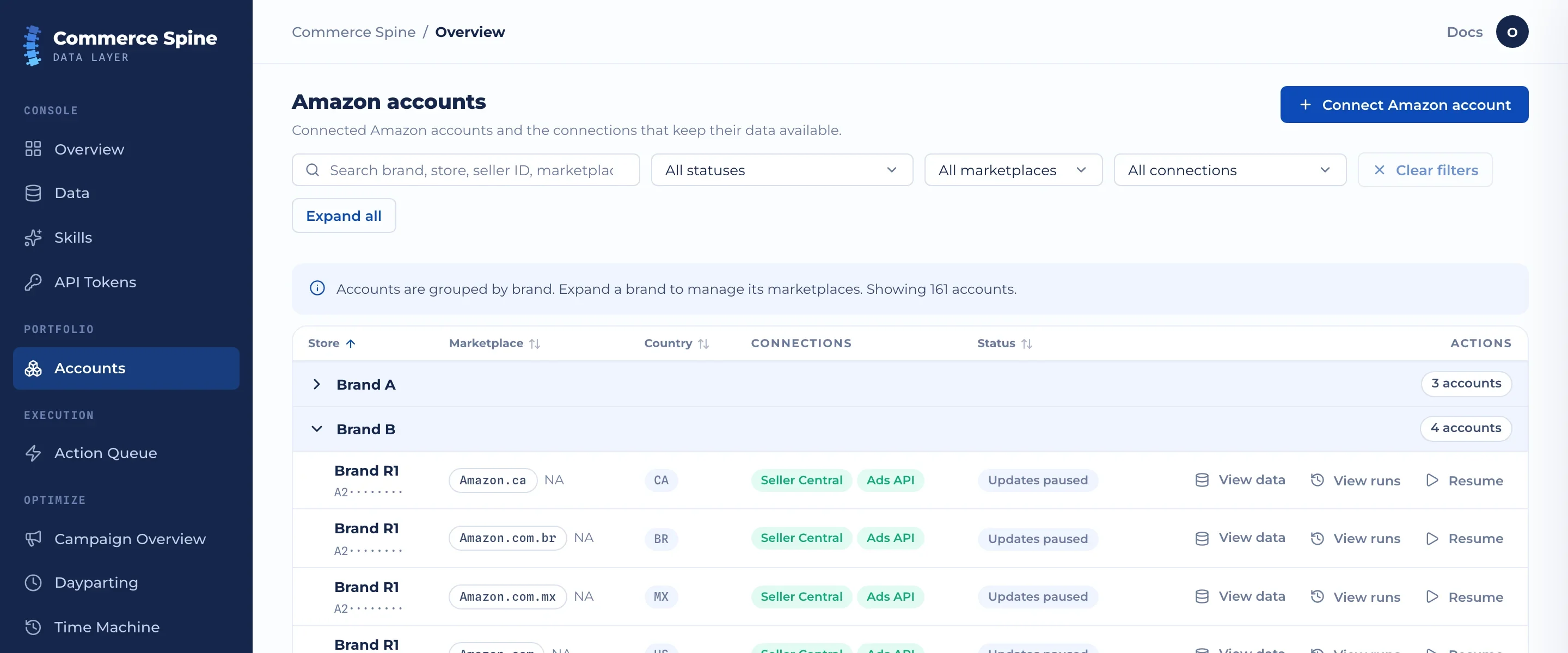
Amazon does not give you one API. It gives you Ads and Seller Central, each with its own auth, shapes, quirks and rate limits. We absorb all of that and hand your agent a single interface. And we are not a connector. A connector proxies live endpoints and forgets everything the moment the call ends. This is a warehouse: your history is stored, joined across sources and query-ready, so your agent can compare this week to last quarter without re-pulling anything.
Connect your Amazon accounts
Authorize Ads and Seller Central through Amazon. We never see your login.
We build your warehouse
We backfill 30 days, then keep syncing. Everything is cleaned and joined across sources.
Query from your own AI
Install the plugin, add your token. Your agent gets the full data dictionary: 247 documented fields.
Built in layers, like a spine.
Each layer stands on the one below it, so every ad change and every suggestion traces back to the same warehouse numbers your agent reads.
Your Amazon data, stored and joined
Ads and Seller Central in one managed warehouse, 30 days backfilled at first sync and kept from then on. Your agent reads it through the plugin or the API.
See the data coverageAd management that runs on the data
The action layer applies reviewed proposals on Sponsored Products: keyword bids, campaign status, negative keywords and placement bids. Every change is logged, and you can follow each one in the console's action queue.
See it in a demoAI suggestions, next
Once organic data lands in the warehouse (how your products sell and rank without ads), an AI suggestion layer reads it next to your ad data and proposes what to change, with the reason for each change.
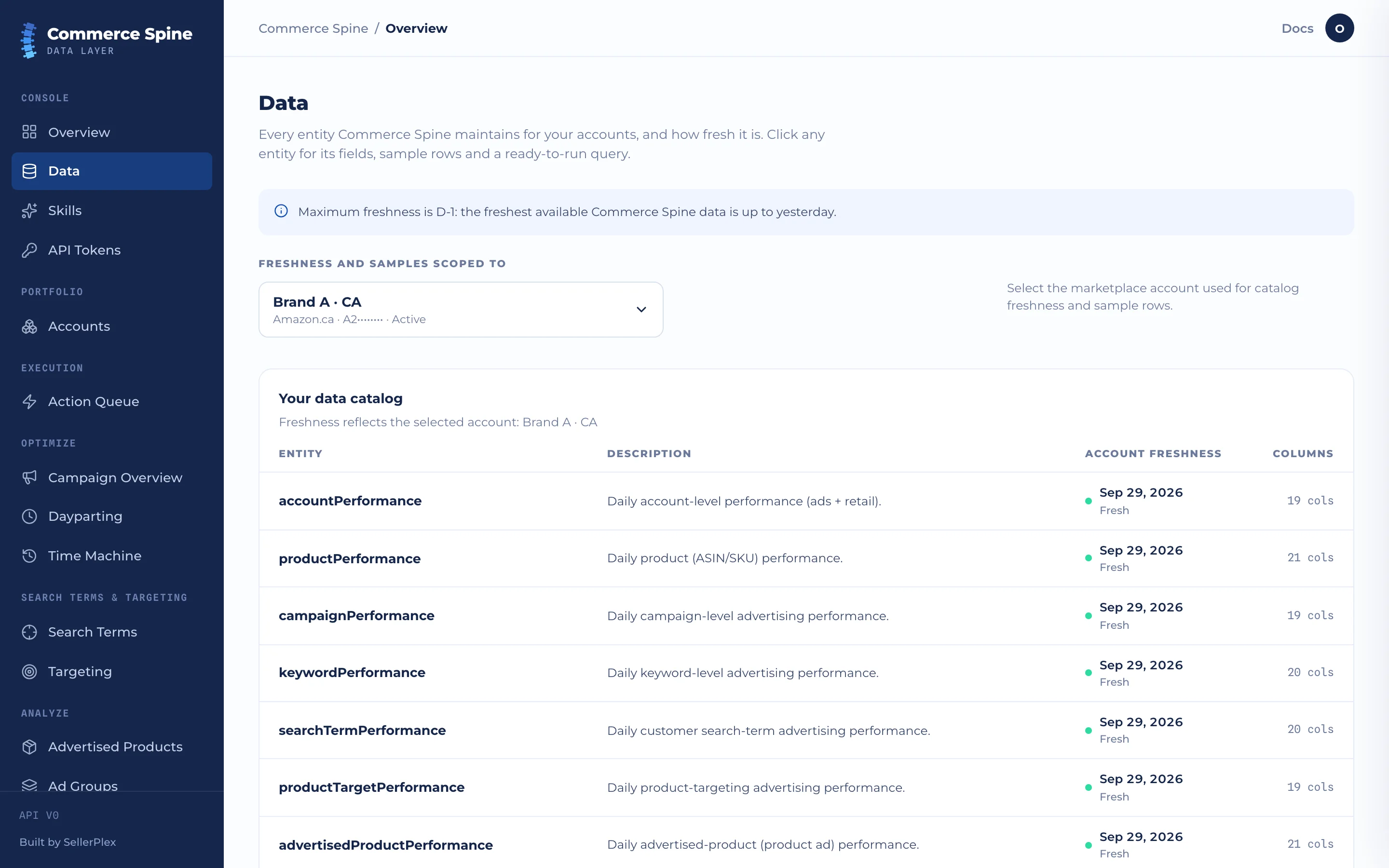
Querying is step one. Building is the point.
Any data tool can answer "what is my ACOS". The reason to put this data inside a coding agent is that the agent does not stop at the answer. It writes the thing that watches the number for you, and it keeps running after you close the laptop.
A wasted-spend board that updates itself
Your agent reads search terms and spend, writes the dashboard and points it at your live warehouse. You open a URL, not a spreadsheet.
Stock and account warnings in Slack
A scheduled check that posts when a best-seller runs low on supply or a listing needs attention. Written once, running from then on.
Monday profit summary, per marketplace
A scheduled job your agent wrote against a stable, documented schema, so the same query returns the same shape every week and the report does not quietly break.
Whatever your operation actually needs
Negative keyword sweeps, margin rollups across brands, an internal tool for your VA. If your agent can write it, it can run it on this data.
You also get the skills our own agency runs on.
This is the part competitors cannot copy quickly. SellerPlex runs a full Amazon agency, and our PPC, supply chain and account health teams have spent years building the analysis methods they use daily. Those same skills and agents ship inside your subscription, so your agent starts out sounding like someone who runs accounts for a living instead of a blank model with database access.
PPC Semantic Analyst
Root-caused, prioritized insights instead of a metrics dump. Tells you what moved, why, and what to look at first.
Ads Query Orchestrator
Plans multi-step pulls across tables so your agent does not reinvent the joins every session.
Profit-First PPC Analyst
Recommendations ranked by profit impact, using your ad data and the costs you bring.
Amazon Ads Entities
A conceptual map of the Ads hierarchy, portfolio to target, linked to the selling entities it spends against.
Amazon seller data coverage and refresh rates.
Stop stitching exports. Ads and Seller Central data arrive joined and query-ready, with your history intact.
One catalog, one contract
Freshness, published
Every live entity in the console shows its last successful sync.
Questions your agent can finally answer.
Just ask, or tell it what to build. Your agent drafts and reports; you decide what happens in your account.
Amazon data API pricing. No credits.
Price is not the reason to pick this, and we would rather you chose us for the data quality. But the pricing model matters, because credit systems meter your curiosity. Nobody can tell you what a credit buys before you spend it, and the meter always runs out in the middle of the analysis that mattered. We think that is a bad way to treat an operator.
Commerce Spine is a flat monthly subscription. Price scales with data volume: how many brand accounts and marketplaces you connect. It never scales with how many questions you ask.
There is a free tier, and it is a real product. One connected Amazon account, 30 days of history, the full catalog and the full API. Not a trial that expires, not a sandbox with fake data. The caps are printed here, the same way the paid caps are.
Your AI costs stay yours. You already pay Anthropic or OpenAI for a model you trust. Keep doing that, at their prices, on the plan you have. We will never mark up tokens or route your data through a model you did not pick.
Your bill should be the most boring thing about your data stack.
Applied per organization, not per token, so minting more keys does not buy more quota. Printed here, enforced in the API, no overage billing. Amazon caps historical data at 90 days; we backfill 30 at first sync for every account and keep everything from that day forward, so your history compounds.
Launch pricing
Start free on one account, upgrade when you connect the second. Both paid plans include 5 hours with one of our senior AI developers, for onboarding, for porting what you already built, and for standing up your first dashboard or alert with you.
One connected account, 30 days of history, 20 queries an hour and 40 a day. Full catalog, full API, every included skill. No credit card, no expiry.
Get started for freeUp to 3 connected accounts (brand and marketplace pairs). 1,000 queries a day instead of 40, a 90-day query window, 150 GB scanned instead of 1.5, all included skills, and 5 hours of senior AI developer time.
Renews monthly at $49 until you cancel. Cancel anytime.
Start on BrandUp to 12 connected accounts across brands and marketplaces, priority support, 5 hours of senior AI developer time, everything in Brand.
Renews monthly at $149 until you cancel. Cancel anytime.
Start on PortfolioFree accounts let us read the connected account to build you a tailored growth proposal. That is the trade, and it is the only thing free costs you. Running more than 12 accounts, or an agency? Talk to us, portfolio pricing scales with connections, not questions.
Scoped by design. Your model by choice.
Every request logged
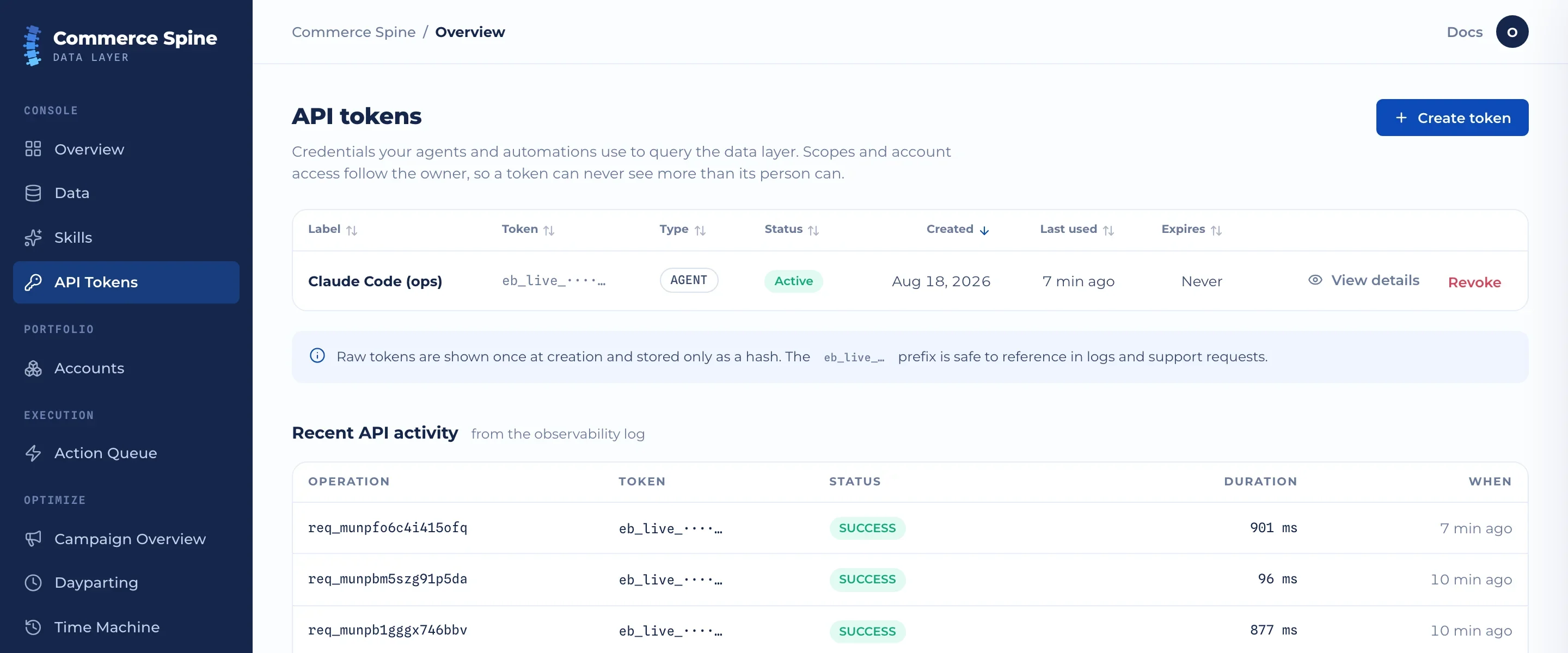
Every request is logged with the token that made it, and each response carries a requestId. Give each agent or script its own token and you can see exactly what it asked for.
Scoped access
Tokens are scoped to your organization's data. Team management in the console controls who holds which token. Revoke instantly.
Your model, your terms
Your prompts and query results go to the model you chose, under your agreement with that provider. We never see your conversations and never proxy your AI traffic.
Standard Amazon consent
Access is granted through Amazon's own authorization flow and revocable there at any time. Your data lives in a managed, isolated data warehouse on Google Cloud.
Agency and software, kept apart
SellerPlex runs an agency too, so we built for that objection: your warehouse is segregated per organization and the agency side has no path into it. Maintenance access sits with the engineers who run the infrastructure, nobody else.
Tools that promise an AI will "run your business" want write access to everything and your trust in an autonomous model. We built the data layer first, and the action layer on top of it works on your ads only: every change it makes is logged, and everything else stays in code you wrote and can read.
The data layer our own agency runs on.
SellerPlex is a full-service Amazon agency behind Amazon PPC management and account management for 6 to 8 figure sellers. Our teams use this exact warehouse and API, with these same skills, against client accounts with real money on the line.
The schema is shaped by people who actually operate accounts, so the joins you need exist and the rollups answer real questions. And when Amazon changes an API or a report format, we feel it the same morning you would, and we fix it because our own teams are blocked too.
We productized our own infrastructure. The alternative was watching everyone duct-tape their own version of it. And it keeps compounding: what we build for our own teams this quarter shows up as a Commerce Spine feature next.
PPC
Bid and budget work on the profit-first skill set, with the action layer making the Sponsored Products changes.
Supply chain
Shipment and stock planning on the same warehouse.
Account health
Monitoring built on the same data pipeline.
Thin on purpose.
Other tools make the web app the product and lock your workflow inside it. Ours holds your accounts, data catalog, tokens and the action layer's ad controls, then gets out of the way. The real interface is the one you already live in. We are not going to build a worse chat window than the one on your machine.
"Couldn't I just build this myself?"
It is the first question every technical buyer asks, and it deserves a straight answer rather than a sales one. Yes, you could. Here is what building on the Amazon SP-API actually costs.
Amazon has to approve you first
Most of the useful data sits behind an application you must build, submit and get approved on Amazon's marketplace. That is paperwork you cannot code around. We already carry that approval, so you skip it entirely.
The hard part is the architecture, not the code
Pulling a report is a weekend. Making millions of rows across Ads and Seller Central land clean, joined and consistent enough that an agent can reason over them without burning tokens or contradicting itself is a different problem. Ours took months of full-time work by people who do this for a living.
It never stops needing maintenance
Amazon changes report formats, deprecates endpoints and shifts fields. Every one of those is an evening you spend repairing a pipeline instead of running your business. When it breaks for us, our own agency is blocked too, so it gets fixed that morning.
You are buying back the boring part
You keep the interesting work: the analysis, the automations, the tools your agent writes on top. You hand off the ingestion, the schema drift, the retries and the access management. That is the whole trade.
Already built something? That is the normal case
Most people we talk to have already wired up some version of this, and the real question is not whether ours is better in theory but what switching costs them. That is exactly what the included developer hours are for: one of our senior AI developers sits with you and ports what you already have onto the warehouse, so you are not rebuilding your own tooling on your own time.
Pick your data layer deliberately.
| Compared on | Bundled AI tools | DIY SP-API pipeline | Commerce Spine |
|---|---|---|---|
| AI model | Theirs, routed for you | Yours | Yours |
| Pricing meter | Credits, undefined per task | Engineering time, infrastructure and maintenance | Flat: $0 for 1 account, $49/mo for up to 3, $149/mo for up to 12, limits published |
| Interface | Their chat window | Whatever you build | Your agent, plugin plus skills |
| Data depth | What their UI surfaces | What you have time to pipeline | A full warehouse joined across Ads and Seller Central; 14 curated entities |
| Scripts and scheduled jobs | Locked to their workflow builder | Yes, you maintain it | Yes, a stable documented schema, we maintain it |
| Works with your other tools | Limited to the integrations they chose to build | You build every connector yourself | Naturally: your agent joins Commerce Spine data with any API it can reach, from Data Dive to your ERP, CRM or own databases |
| Who decides what happens in your account | Their automation, often with write access | Your call | You do: your agent drafts, and every ad change the action layer makes is logged |
| When Amazon changes an API | They fix it, eventually | You fix it, at 2am | We feel it the same morning you do, our own agency is blocked until it's fixed |
If you want your AI to finally know what is happening in your account, this is the layer it has been missing.
Commerce Spine questions and answers.
Something else? Book a demo or write to [email protected].
What is Commerce Spine?
What does the action layer do?
Why is there no chat UI or bundled AI?
Which AI tools does it work with?
Why can't I just vibe-code this myself?
How is pricing metered?
Can Commerce Spine change anything in my Amazon account?
How fresh is the data?
How is this different from bundled AI seller tools?
Are you a connector, or a warehouse?
Why use a managed Amazon data API instead of building on SP-API?
Does Commerce Spine require an MCP server?
SellerPlex is also an agency. Can its people see my data?
Where does my data live and who can see it?
Get started for free. One account, no card, no expiry.
We onboard in small cohorts so every backfill, every schema question and every skill gets attention from the team that built it. Bring the AI you already run. We will bring the data.
- Free forever on one connected account
- Your model, your harness, scoped tokens
- 5 hours with a senior AI developer on every paid plan
- Cancel anytime
Prefer to talk first? Book a demo.
Questions or need a hand? [email protected]
How many ASINs are you running?
Sizes your warehouse and backfill
Pick a range to continue
For businesses; users must be 18 or older.
You're in
Onboarding call booked. Watch your inbox for the confirmation and your warehouse setup details.